A Heart From Jenin, 2006
The film tells the story of Ahmed, a 12-year-old Palestinian boy who lived in the Jenin refugee camp in the West Bank. In November 2005, he was killed by an Israeli sniper. After his death, Ahmed’s parents made a remarkable decision: they donated his heart to someone on the other side of the wall—in Israel. That someone was Samah, an Israeli girl who lived with Ahmed’s heart for years. For Ahmed’s parents, their son lived on through her, as a symbol of hope for peace between the two peoples. A gift can spark change—when there is someone on the other side willing to accept it. Watch the film here: https://www.youtube.com/watch?v=D_57fiImxFc
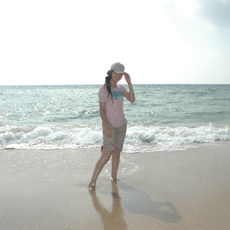
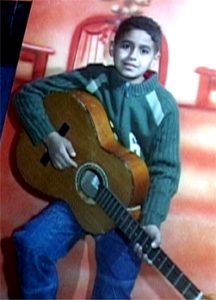 Ahmed’s mother said that the donation was made in the spirit of Salam (peace) with Israel: “We were sending a message to the whole world that we loved peace. We donated six of Ahmed’s organs to the hospital. It was in the hospital’s hands to decide on the donation, regardless of whether the recipient was Jewish, Muslim, Druze, or Christian.” A 12-year-old girl, Samah, received Ahmed’s heart. The film is also about her life in Peq’in, Israel. She sometimes took charge of the camera and filmed. In the film, she calls Ahmed’s father and mother in Jenin and address them as ‘father’ and ‘mother.’ The Palestinian family visited Samah several times. Samah’s father said that Ahmed’s family could regard his daughter as their own. Their home became a place where busloads of visitors came to hear the extraordinary story and talk about peace.
As a filmmaker, I was welcomed as someone whose presence could contribute. I portrayed the profound sense of empowerment that every person should feel they possess: the Palestinian family offering a gift no politician could ever give, breaking isolation by reaching out to the Israeli family willing to accept it. The gift of a heart pierced the wall — because it was received.
Background
Jenin is located in the northern part of the West Bank. The refugee camp, now integrated into the city, is home to about 13–15,000 people according to PCBS and UNRWA. It was originally built by refugees from Haifa after the 1948 war and has remained one of the most frequently targeted areas throughout the history of the Israeli occupation. Ahmed’s grandparents fled from Haifa in 1948, and the family had lived in the camp ever since. The Israeli occupation of Palestinian territories began after the Six-Day War in June 1967, when Israel captured the West Bank, Gaza Strip, and East Jerusalem. The conflict is complex, and the occupation deeply affects life in Palestine.
In April 2002, the Jenin Refugee Camp was completely destroyed by Israeli occupation forces. The United Nations was not allowed in by the Israelis until a week later. During that week, only a handful of photographers managed to find a way into the city—I climbed a mountain to get in—so there is very limited documentary material. I have uploaded all my photos (around 250 images) along with texts by my writer friend Ana Valdés here: https://ceciliaparsberg.se/jenin/
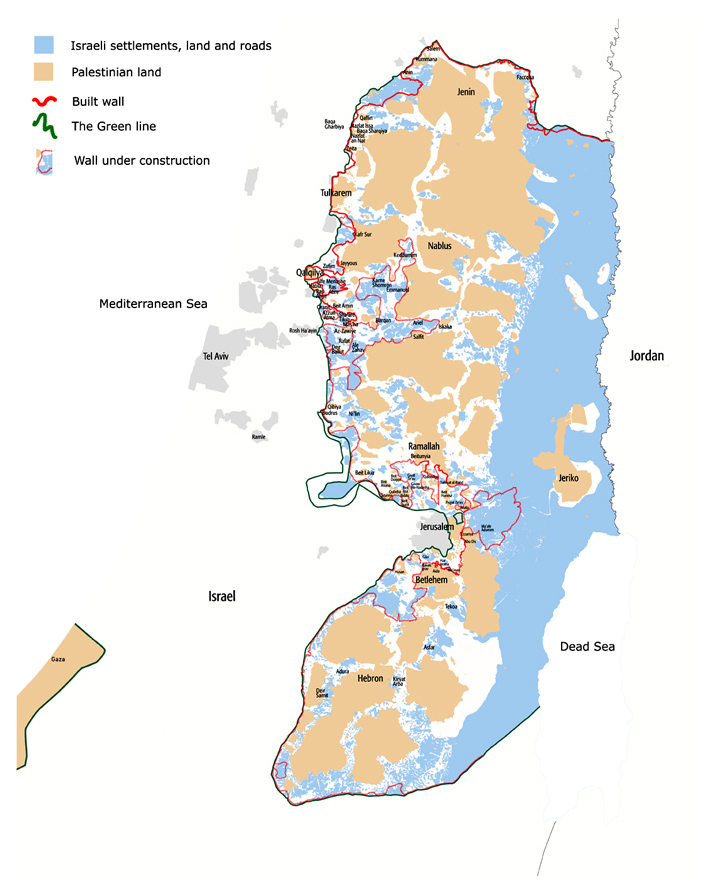
Two months later, in June 2002, Israel began constructing the separation barrier, which runs along and inside the West Bank, separating Palestinian communities from Israel (see map below). The barrier was partly an eight-meter-high concrete wall and partly a fence. On the Israeli side, the area adjacent to the barrier was a militarized no-man’s-land, guarded by soldiers and trained dogs.
I returned to the Jenin Refugee Camp in November 2005 to see how it had been rebuilt. During that visit, Ahmed was shot dead by an Israeli sniper.
To me, these two ordinary families reveal something profound: even in the midst of violence and division, human connection can break through walls—both physical and symbolic. Their actions illuminate a path that politics so often fails to find: a path where empathy and courage create space for dialogue. A heart crossed the border, and in that gesture lies a message to the world: peace begins when someone dares to reach out—and someone else chooses to accept.
The film as an installation has been shown at around 25 venues, including:
- 2006 – BildMuseet, Umeå (www.crusading.se)
- 2006 – Fotografins Hus, Stockholm
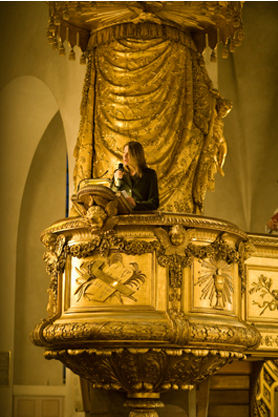
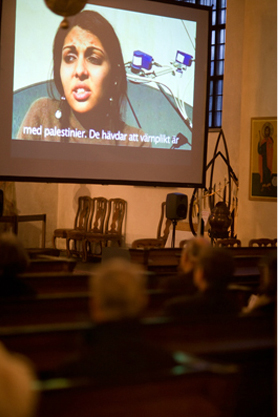
- 2007 – LänsMuseet Västernorrland and Jacob’s Church, Stockholm
- 2007–2008 – Malmö Museer, Malmö
- 2008–2009 – Museum of World Culture, Gothenburg (www.varldskulturmuseet.se)
…and screened
Film Screening + Seminar
- Lens Politica – Film and Media Art Festival, Helsinki, 19–23 November 2008 (www.lenspolitica.net)
- MKC, Fittja, Stockholm, October 2008
- School of Global Studies, Gothenburg, September 2008
- Kulturverkstan, Gothenburg, September 2008
- Center for Peace Research / Border Poetics Group, Institute for Culture and Literature, Tromsø, Norway, August 2008
- FN-Sambandet, Verdenteatret, Tromsø, Norway (www.fn.no/distriktskontor/nord/internasjonalt_seminar)
- Keynote Speaker at the conference Sensitive Peace Research, Tampere Peace Research Institute, University of Tampere, 16–18 April
…and more, se CV
Photos from the exhibitions (Obs- click on images to enlarge)
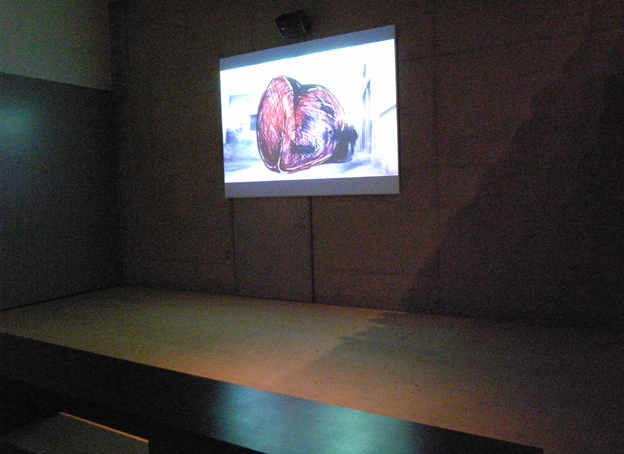
World Culture Museum, Göteborg
The wallpaper is made of 300 photos of the demolition of the Jenin camp, 2002 (see Jenin) Jenin is – as a shadow – written left to right on one wall and in Arabic; right to left, on the other wall.
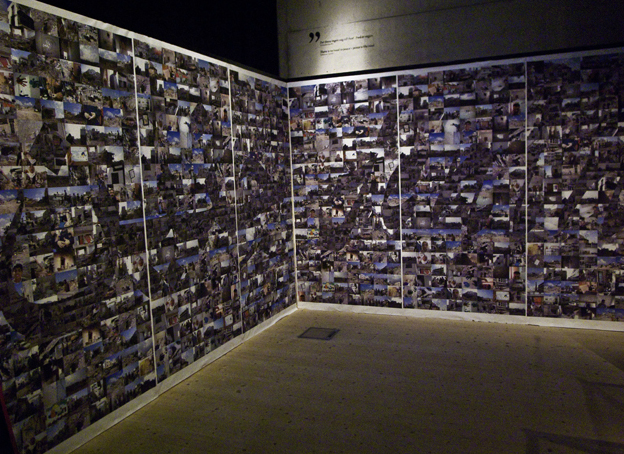
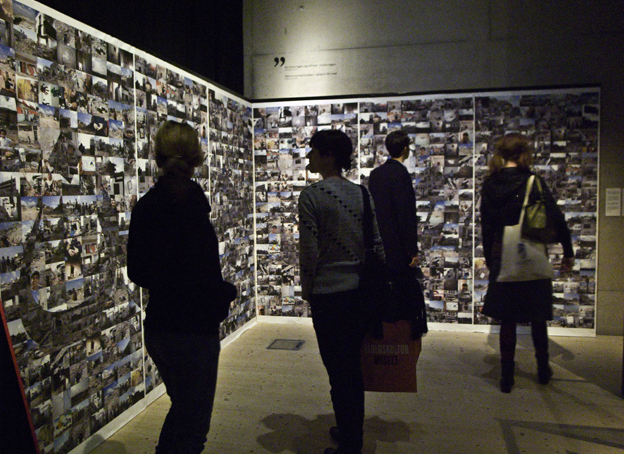
Fotografins hus Malmö
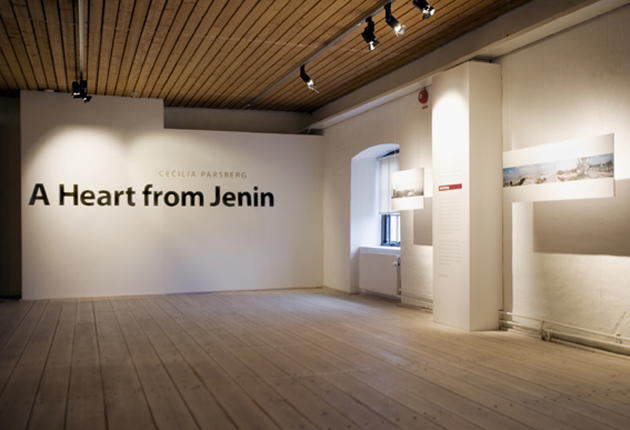
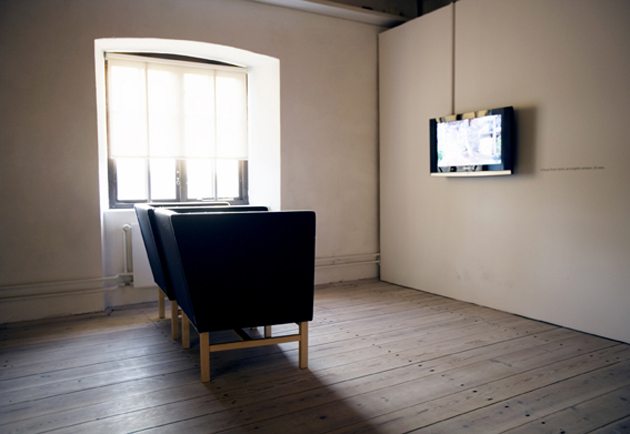
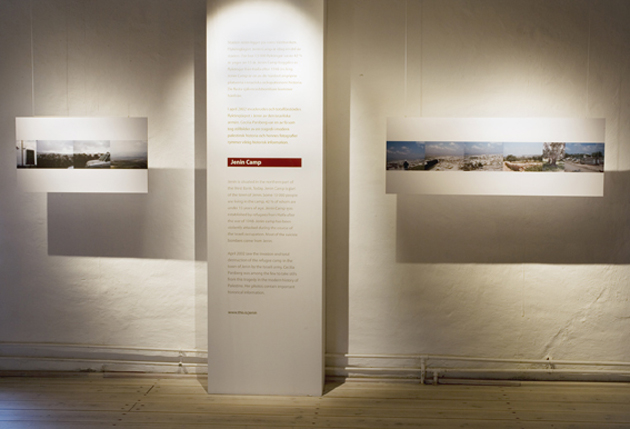
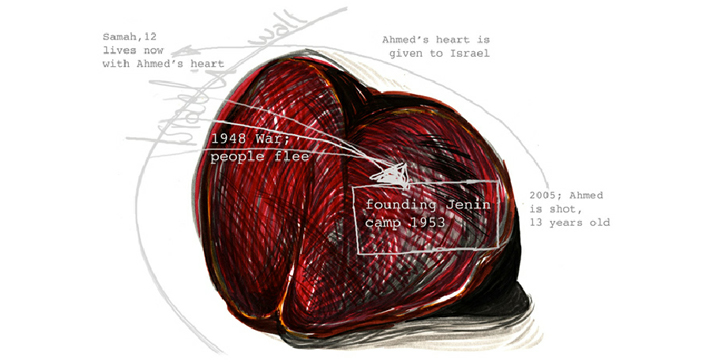
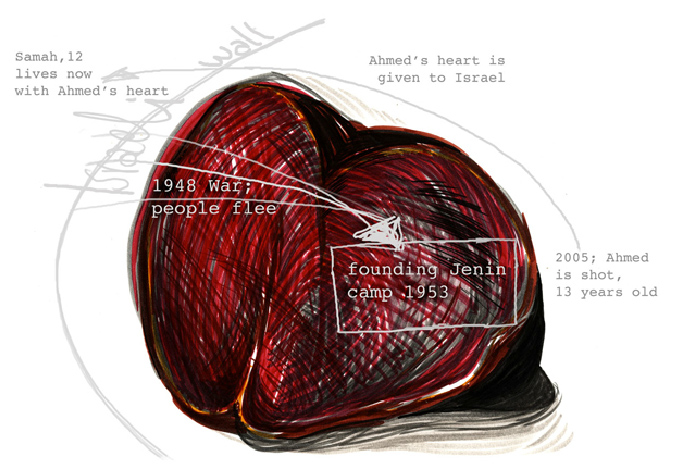
The installation consist of: -a shorter version of the film: 30mins -a wall paper: 2 X 6 meter showing 300 photos from Jenin camp, the destruction in April 2002 -a map showing borders, built wall and planned wall -a print of the heart and a drawing of the history: 50 X 70cm
About A heart from Jenin, text by Jan-Erik Lundström, head of Bildmuseet, Umeå (2006)
Cecilia Parsberg’s artistic practice have often brought her towards the hazardous and complex but important and necessary political undertaking in speaking about the other, the marginalized or underprivileged of society (engaging both sexual, social and political displacement and suppression in her work), or the underdogs in a political conflict such as the Palestinians; generating challenging works of art, blending documentation and activism, where often the artist herself is present as witness, investigator, mediator, supporter. Over the last few years, Parsberg has maintained a particular focus on Palestine, the living conditions of Palestinians and life on the occupied West Bank and the Gaza strip, resulting in several projects such as the videos I can see the House or To Rachel, with the story of the killing of the young American activist Rachel, run over by an Israeli tank or the action East or West, Home is Best. One of Parsberg’s visits, in April 2002, coincided with the brutal Israeli army invasion of the village and refugee camp Jenin on the West Bank, during which Jenin was more or less almost completely demolished and many Palestinians killed, the numbers uncertain since Israel blocked any inpendent investigation. Parsberg was able to enter Jenin in the early aftermath of the invasion, managing one of the few documentations of its kind of the extent of the destruction of Jenin. This material became the website www.this.is/jenin, a rich archive of images and written testimonies on the fate of Jenin. The photographs on display in the present exhibition are sourced from this body of photographs, supplanting the website notion of an open source archive with offering the opportunity to re-focus and engage more specifically with individual images and their stories. It does not however change the overall sense of perverse, meaningless, and unbounded mayhem. In the exhibition space, the Jenin photographs are juxtaposed with the video A Heart from Jenin, the artist’s return to a largely rebuilt Jenin in November 2005, three years after the Israeli attack on Jenin. Rebuilt yes, but hardships in Jenin continue.
A Heart from Jenin’s key narrative is the extra ordinary story of Ahmed, a 13-year old Palestinian boy who is shot to death by Israeli soldiers, and becomes clear that the boy will not survive, decides to allow the child’s organs to be donated. The 26 minutes long video traces the actual event of the boy’s casualty through conversations/interviews with the near family, with people from the neighbourhood but also with writers, university professors – one from Israel – and intellectuals, enabling a broader picture of life on the West bank. But it is the gesture of the parents, the donation, which defines the film. For as it turns out, the boy, when pronounced dead, becomes the donor of five organs. His heart is given to a 12-year old Israeli girl from Haifa, who has for years been waiting for a heart transplant and whose life now is saved. The tragic and horrible killing of Ahmed brings out, through the parents’ act of allowing donation, a gesture of reconciliation, of appeasement. Especially that the heart is not a metaphor; the heart of Ahmed lives on in the body of the Israeli girl – as beautifully illustrated in the drawing by Cecilia Parsberg on the journeys and meanings of a heart, presented in the exhibition. Their parents are quoted as saying: “we want them [Ahmed’s parents] to consider our daughter as their daughter”. From those bestowed the most pain come the most human of gestures.

Jacobs church, Stockholm