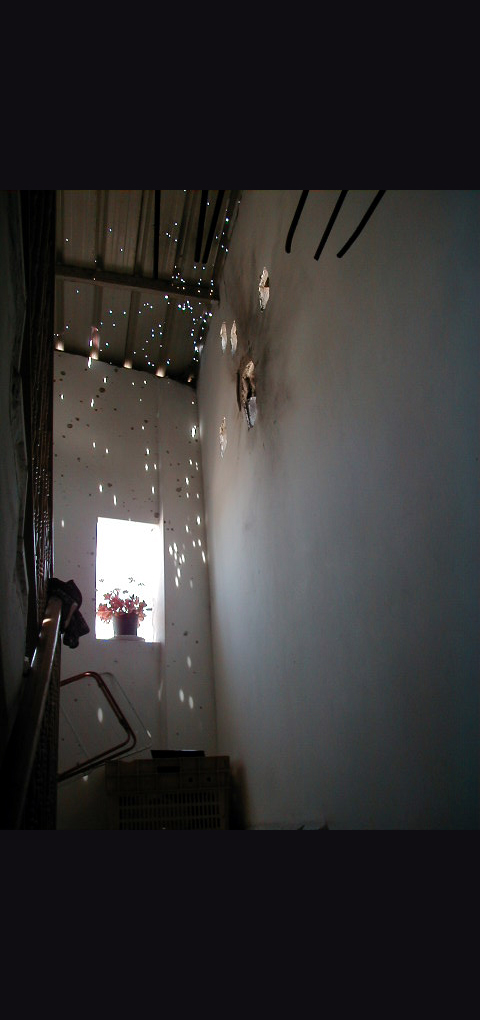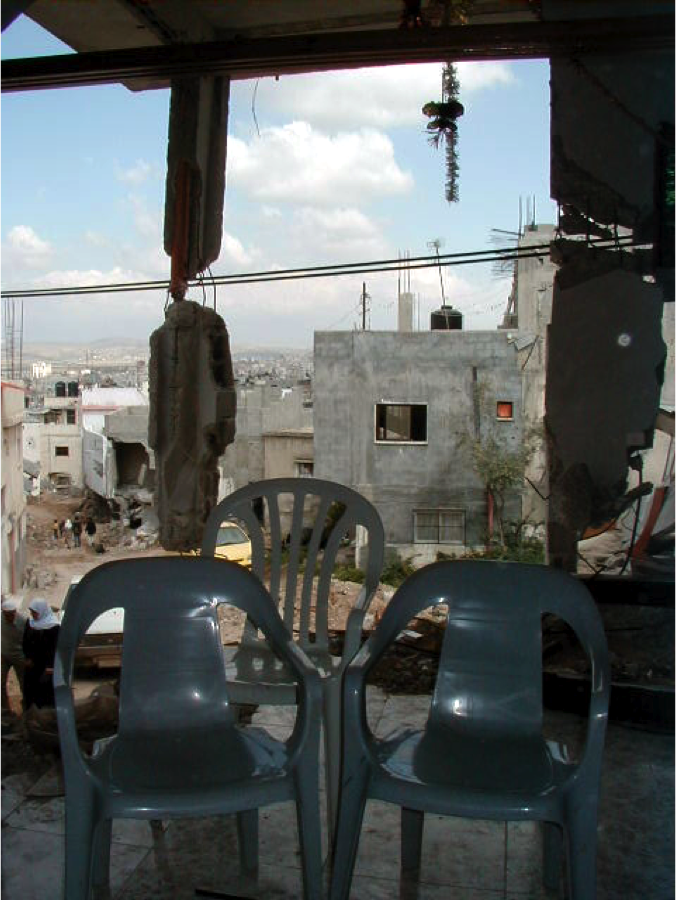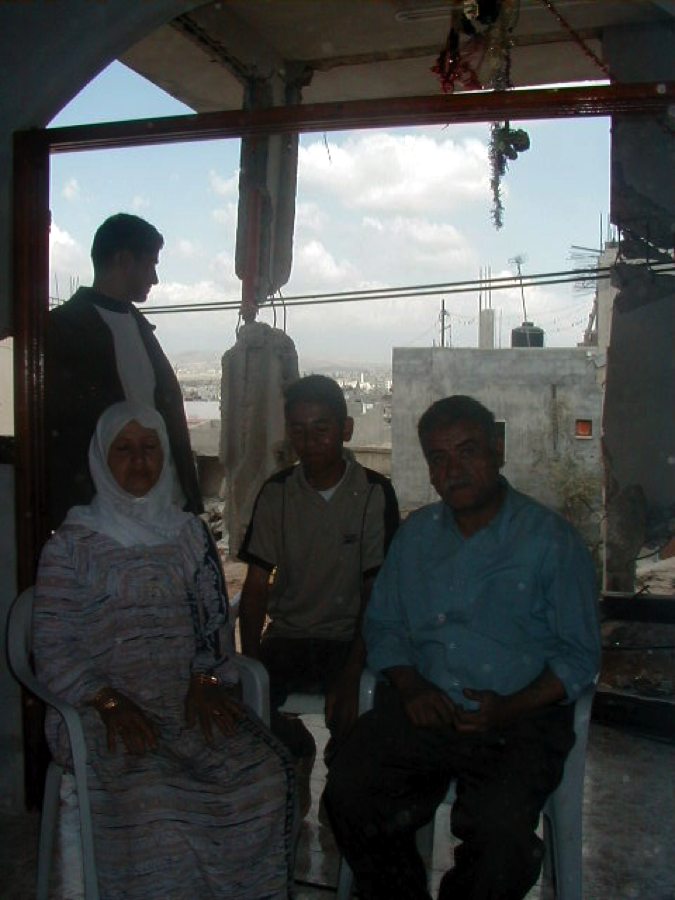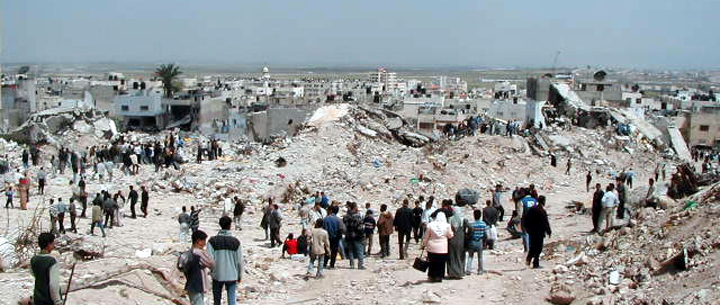
Joret Ed Dahab, Jenin, April 2002

Joret Ed Dahab, means the hole where one can search for gold.
Power
Stockholm 2002-09-01
What’s in my power? As the human being I am, born into a specific life situation, in a country – Sweden – in my profession as a visual artist… What do I experience, what do I see, what do I react to? How come there’s a feeling that one’s time is not free? That freedom of thought doesn’t cohere with freedom of action.
What is it like to be occupied by something that has been forced upon you? What happens to a person living in a country that is occupied? It’s not just that the land you walk on, the airspace above your head and the water resources are controlled, but also your communication with others – those who are outside the checkpoints where you need a specific laissez-passer to go to work or take your children to school. Even your movements of thought become limited. As Waleed, a friend in Palestine, expressed it: “My mind is occupied. I have no time to think about anything else than survival.”
I was in Ramallah when the Second Intifada (also called the Al-Aqsa Intifada) began on September 28, 2000. In December 2001, I returned to Palestine together with my colleague Ana Valdés to—according to the invitation—make contacts and formulate ideas for a future cultural exchange. We believe that cultural arenas are spaces where different perspectives can be presented and discussed in ways that differ from media and political discourse.
Last spring, the emails from our contacts in Palestine became increasingly desperate. Ramallah was under siege, and then Jenin was struck. They needed help and witnesses to what was happening there. Ana and I traveled to Palestine and spent April 20–23, 2002 in Jenin. In the media, one learns about events through numbers, but we met people. The dead and wounded, and those who survived, have names; they are somebody. Each has a name, and each has relatives and friends.
In June, we published a website: https://ceciliaparsberg.se/jenin/ showing 450 photos and a number of recorded stories told by people who lived in the camp. There is also a detailed map on the site showing every house – which were destroyed and those possible to repair. Now, as I am writing this, more homes and quarters have been destroyed after several new raids.
Even in democratic countries at peace, there seems to be – and I wonder why – a communication gap between people and the elected politicians who have been given a mission and therefore can change structures in society. Do we really trust the ones we elect? Do the ones we elect trust us? The question is: Do we really wish each other well?
Seven Israelis dead and fifty-four wounded in the blast of a suicide bomber in Jerusalem. An invasion of tanks in Nablus is the revenge – more dead, but now Palestinians. Everyone in Israel and Palestine has someone close who has been attacked.
One month after the publication of our website, I received an email from a man in Canada asking if I hate Jews. His email was aggressive; I wondered if I should answer it.
From: “Daniel”
To: ceciliaparsberg@yahoo.com
Subject: Curious???
“I was just curious why you don’t just admit the truth that you are Nazi scum? I’m certain if you had lived around 60 years ago you would have raced over to Auschwitz and Treblinka to join in on the fun. I hope evil cunts like you get cancer and have a painful lingering death.”
He ended by writing his full name and address.
I answered:
“Your mail to me is violent. Why? You are in Canada and have the possibilities to raise questions about how we all can live together in this world. As my friends, both Israelis and Palestinians, I don’t exclude people because of their sex (as you do in your mail to me), race, religion or colour of skin. We can all live together if atrocities stop, violence is not used anywhere (so I think you should stop using it; to speak is to act).”
Cecilia
Two weeks later, he wrote to me again:
From: “Daniel”
Subject: My apologies if you construed my previous mail as violent, however…
“My nasty e-mail to you previously was simply an example of the sort of visceral response I have towards people whom I perceive, in all honesty, as being very similar in certain key respects to people who tortured and murdered several members of my family. I was just curious why you don’t boycott people who do this: An explosion at Hebrew University in Jerusalem kills 7 and injures 80+. Police say the blast is a terror attack. Is it because you simply hate Jews?????”
Yours truly, Daniel
I answered that I don’t hate Jews, that we all are individuals and we can’t accept being packaged in groups like religion, nationality and so forth – and that there are many Jews who discuss this, for example the organization Not in My Name https://www.jewishvoiceforpeace.org/resource/not-in-my-name-divest/ In war, people become anonymous, but each of us has a responsibility for how we act towards our neighbour.
Activists around the world organize, many of them young people, arguing and acting for human rights – that every human being should have the right to affect and change the life situation he or she is born into. I also wrote that I admired the organizations Bat Shalom and Women in Black, in which Israeli and Palestinian women cooperate and help each other handle everyday life situations, like Israeli women meeting up and taking care of Palestinian children when they are going to school, so that they don’t have to wait for hours at a checkpoint. I think these women should have a place in politics because through their actions they show possibilities to solve conflicts.
During the nineties, a slogan circulated: “The personal is the political” – and thus the general. It has to do with how we communicate with each other, directly and indirectly. A contemporary artist has the power to connect the images made to the impressions images create, to see the relation to history, source, reference and visualize a future. These connections span a vast and limitless zone. (One has to be able to demarcate a certain area, a context, to really understand and mediate what one sees – this happens within each person.)
The title of my piece is Joret Ed Dahab, which means “the hole where one can search for gold.” The large photograph was one of the 500 photos I took in Jenin and the only one I took because I saw something beautiful. When we walked inside what was left of the house, passing a set of stairs, there was a remarkable light and I turned around to be in it. The light came through holes in the wall and ceiling and through the window I saw a landscape of houses – an infinite landscape of shadows and voices. The borders dissolved, the holes shone and I saw how fragile they were, all these borders we build on, as traces of a game that is no longer played.
Mohammed Abualrob has written Joret Ed Dahab in Arabic on one of the paper sheets. This is the original name of the place – the part of the refugee camp in Jenin that was destroyed in the beginning of April 2002. Mohammed grew up in Jenin and since February 2002 he has been studying in Uppsala, Sweden, in the course Peace and Conflict. I have made a drawing of his text. These drawings are an important part of the work. I don’t know how to write in Arabic; it means it’s not possible to fully understand another person’s situation, but it’s possible to imagine or feel it.
This work is exhibited at Botkyrka Konsthall, Sweden, 14th of Sept-3rd of Dec 2002
Fischer Gallery, Seattle, 11th of November-14th of December 2002
Reset Gallery Philadelphia, February-March, 2003
Edsviks Konsthall, Stockholm, March 2003
AAO Gallery, Tokyo, March 2004
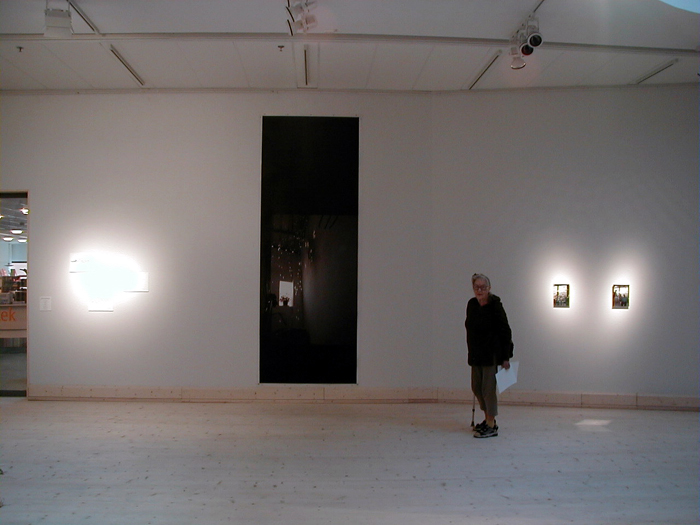
Botkyrka Konsthall, Botkyrka, Sweden, 2002